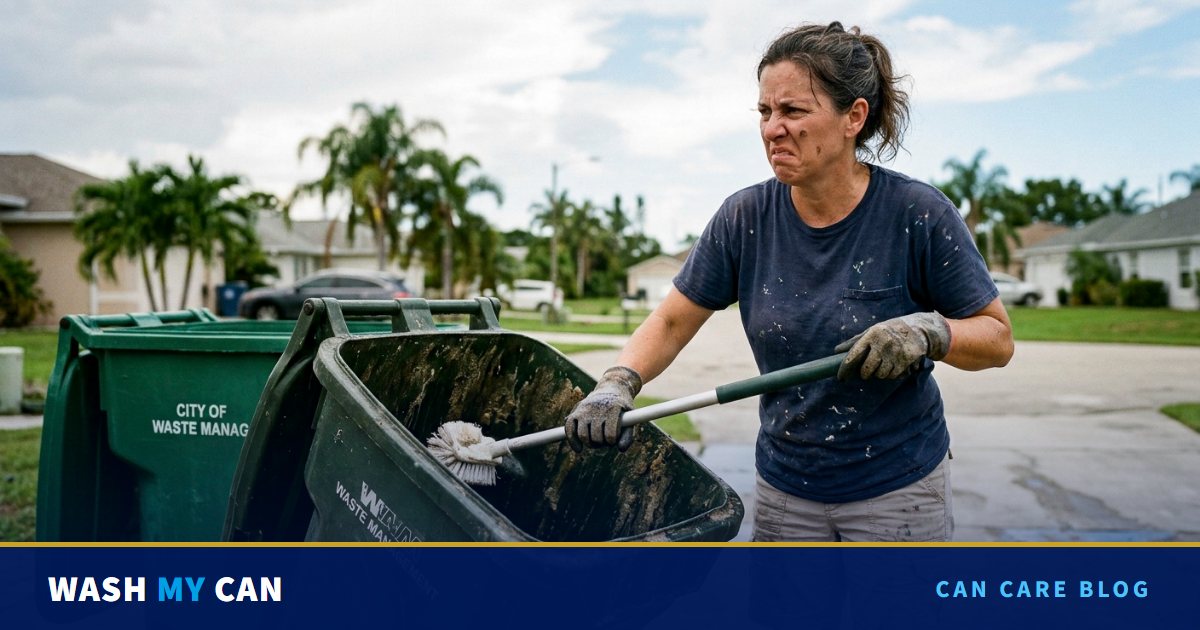
Saturday morning. You drag the can onto the driveway, tip it on its side and squeeze the hose trigger. The first blast kicks up a smell you can almost chew: sour milk, old chicken, something sweet and rotten underneath. Gray water slops out of the mouth of the can and runs in a thin brown ribbon toward the street. Twenty minutes later your arms are wet to the elbow, your sneakers are splashed, and the bottom of the can still feels slick when you run a glove across it.
If that sounds familiar, you have already asked the question a lot of Palm Beach County homeowners ask: is it worth cleaning a trash can yourself, or should you pay someone to do it? Here is an honest look at DIY versus professional trash can cleaning, so you can decide for your own home.
What you are actually trying to wash away
A trash can is not just dirty, it is alive. Food scraps, meat packaging, leaky bags and the liquid that pools at the bottom feed bacteria, mold and pests. Under ideal conditions, bacteria such as E. coli can double about every 20 minutes, and a warm, humid Florida afternoon is close to ideal for most of the year.
You know the signs. The rotten sweet stink that hits you when the lid comes up. The low buzz of flies circling the rim and the faint wet rustle of something moving under a torn bag. The tacky film on the handle that sticks to your palm. The black speckles of mold in the corners and, on a bad week, pale maggots squirming in the puddle at the bottom. Get close enough while scrubbing and that sour, metallic taste settles at the back of your throat. That is what a cleaning has to deal with, not just a few stains.
The DIY method, step by step
Most people who clean a garbage can at home do some version of this: empty it, rinse it with a garden hose, add dish soap, bleach or a store cleaner, scrub with a long brush, rinse again and leave it upside down to dry. Done carefully, it can make the can look and smell better for a while.
The trouble is in the details. Garden hose water is cold, and cold water does a poor job of breaking down grease and the slick layer of grime stuck to the walls and floor. A hose rinse moves mess around, it does not sanitize. Scrubbing the bottom of a tall wheelie bin means leaning deep inside it, face to face with the smell. Cleaners need time on the surface to work, and most people rinse them off too soon. And in Florida humidity, a can that is left damp may start to smell sour again surprisingly fast.
Where the dirty water goes
This is the part of DIY can cleaning nobody thinks about. Every drop of that gray, greasy rinse water has to go somewhere. On most driveways it runs down the concrete, into the gutter and toward the storm drain, carrying food residue, cleaning chemicals and whatever was growing in the can along with it. Some of it soaks into the lawn. Some of it dries on the driveway as a dark stain that smells faintly sour on the next hot day.
Many storm drains lead toward local waterways rather than a treatment plant, which is why it is a good idea to keep garbage water out of them. You are cleaning one thing and making a mess somewhere else.
What DIY really costs you
When people compare bin wash cost, they often count only the price of a service. DIY has costs too: the brush, the bottle of cleaner, the gloves, the water and, most of all, your time. It is a messy chore that tends to get pushed back week after week, and the longer it waits, the worse the can gets. Many homeowners clean their can once, find it miserable, and do not do it again until the smell forces them.
How a professional trash can cleaning works
Wash My Can takes the whole job off your plate. We come by after your trash is collected, so the can is already empty, and you do not need to be home. Our state of the art cleaning trailer blasts the inside and outside of each can with 200 degree high-pressure hot water to clean, sanitize and disinfect it. That heat and pressure reach the grime on the floor and walls that a garden hose leaves behind, and our wash kills bacteria and disease-causing germs. We finish by deodorizing the can with eco-friendly products, then put it back where you keep it.
And the dirty water? All of the wastewater is safely contained in our trailer. Nothing runs onto your lawn, down your driveway or into the storm drain. That is the biggest difference between a professional wash and a driveway hose job.
DIY vs professional at a glance
Water temperature: a garden hose is cold, our trailer uses 200 degree hot water. Sanitizing: a rinse moves mess around, our wash kills bacteria and disease-causing germs. Runoff: DIY water usually ends up on the driveway, lawn or street, ours is safely contained in the trailer. Your time: DIY takes a chunk of your weekend, a professional visit takes none of it. Consistency: DIY tends to happen when the smell gets unbearable, a plan keeps the can clean on a schedule.
So, is it worth it?
If you only need a quick refresh and do not mind the smell, the splash and the runoff, DIY can get you by. But if you want a can that is actually sanitized, no chores on your weekend and no garbage water running down your driveway, a professional service is worth it, and it costs less than many people expect.
Plans start at $25 a month for monthly service, $35 for bi-monthly and $45 for quarterly, our most popular plan. Want to see the difference first? A one-time trash can cleaning is $65. Every plan includes 2 cans, extra cans are $10 each, and there is no contract. Learn more about our residential trash can cleaning.
Put the brush down and keep your Saturday. Join the Wash My Can launch list today, or call us at 561-414-8682, and let our trailer handle the dirty work for you.
Skip the scrub brush and let our trailer do the dirty work
We clean and sanitize your cans with 200 degree water and keep all the wastewater in our trailer. Plans from $25 a month, 2 cans included, no contract.